
Questions
Every pilot begins with questions.
You do not need to understand the entire aviation world before you begin. Start with what you want flying to become.
Browse by topic, search for what you are wondering about, or read the plain-language guide to the words. Where an answer depends on your circumstances, it says so — and the team will confirm it with you.
Start here
Start with what you are wondering
Pick the one that sounds most like you. It moves the relevant questions to the front — it does not decide anything.
Or go straight to it
Search the questions.
Try a licence, a word like medical or visa, or an abbreviation such as PPL.
Browse by the moment
There are no silly questions when you are learning to fly.
Every answer says how certain it is, and where to read more. Nothing here is hidden behind a hover.
- General answer
- Applies to most prospective students.
- Depends on your training route
- The detail depends on which course you are heading for. The team confirms it with you.
- Requires document review
- Depends on your logbook, licence or training records, which the team reviews first.
- Confirm with the relevant authority
- Set by SACAA or the immigration authorities, not by Eagle Air.
Before the first visit
Starting to fly
You have never flown, and you want to know if that matters.
Yes. Many Eagle Air students begin with no previous aviation experience at all.
Training starts from the beginning: the Private Pilot Licence assumes you have never touched an aircraft. Your instructor takes you from a first briefing to your first solo.
General answerLink to this questionThe Private Pilot Licence (PPL). It is the foundation for everything that follows.
Whether you want to fly for the pleasure of it or build a career, the comes first — it is the prerequisite for professional training.
General answerLink to this questionYou can usually begin training at about 15 or 16; a licence is issued from 17.
In the school's own words: applicants should typically be at least 15 to 16 years of age to begin training, with a minimum age of 17 required for licence issuance.
If you are close to those ages, ask the team — they will tell you what you can start now and what waits until later.
General answerLink to this questionNo particular school subjects — but you must be medically fit and proficient in English.
There are no strict subject requirements, though a basic understanding of Mathematics and Science is advantageous. You must be declared medically fit by an approved aviation medical examiner and demonstrate proficiency in English.
General answerLink to this questionNo — it is not a requirement. Some people like to start that way.
If you would rather feel it before committing to a course, say so when you get in touch and the team will talk you through the options.
General answerLink to this questionYes. Come and see the hangar, the aircraft and the simulator first.
Eagle Air is at Hangar 58A, Wonderboom National Airport in Pretoria. Arrange a time with the team and they will show you around.
General answerLink to this questionYourself and your questions. Nothing formal is needed to talk.
Documents come later, once you and the team have agreed a route. If you have flown before, bringing your logbook helps the conversation.
General answerLink to this questionA briefing, a flight with an instructor beside you, then a debrief.
Every training flight has the same shape: you plan it on the ground, fly it with an instructor, and go through it afterwards — what happened, what to fix, what comes next.
General answerLink to this question
Before choosing a course
Licences and ratings
What the qualifications are, in plain words.
A licence lets you fly. A rating adds something specific you are allowed to do.
The Private and Commercial Pilot Licences are licences. A Night Rating, Instrument Rating or Multi-Engine Rating is added to a licence you already hold, and each extends what you may do.
General answerLink to this questionThe licence that lets you fly an aircraft yourself, and carry passengers.
Learn to fly an aircraft yourself, for the enjoyment of it or as the first step of a flying career.
General answerLink to this questionFly for yourself and your passengers — but not for payment.
A holder is not permitted to fly for remuneration and may only operate aircraft for personal or recreational purposes, often as a step toward a higher qualification such as a .
General answerLink to this questionThe licence that allows you to fly as a pilot for payment.
Qualify to fly as a pilot for compensation or hire. It is the licence a professional flying career is built on.
General answerLink to this questionYes.
The Private Pilot Licence is the foundational qualification for any professional flying career and is a prerequisite for progressing to a .
General answerLink to this questionInstructing once you hold an Instructor Rating, and some airline entry roles depending on demand.
Graduates may pursue employment as flight instructors once they have completed the required Instructor Rating, which builds valuable hours. Certain airlines may recruit low-hour holders as Second or First Officer, depending on operational demand and recruitment criteria.
Employment is never guaranteed, and recruitment depends on the industry rather than on the school.
General answerLink to this questionIt adds the privilege of flying after sunset.
A rating added to a licence you already hold, flown partly on instruments and partly at night, with its own test.
General answerLink to this questionIt lets you fly on instruments alone, without outside visual references.
Adds the ability to fly under Instrument Flight Rules when you cannot see outside. Part of the training may be flown in Eagle Air's simulator.
General answerLink to this questionIt moves you from one engine to two.
Training on more complex aircraft with two engines — a step most professional routes include.
Depends on your training routeLink to this questionIt qualifies you to teach student pilots.
A common route after a : instructing builds hours and experience while you work in aviation.
Depends on your training routeLink to this questionAirline Transport Pilot Licence — the highest level of pilot licence.
It is the licence for pilot-in-command of multi-crew aircraft such as airliners, reached after a and considerable experience.
Depends on your training routeLink to this questionAn informal industry phrase, not a licence Eagle Air issues.
People use it for the stage where the theory is done but the experience requirements are not yet met. What actually applies to you depends on your route.
The exact requirement depends on your intended training and current experience. Eagle Air will confirm this with you before formal enrolment.
Depends on your training routeLink to this questionFlying to accumulate the pilot-in-command time a higher licence requires.
Build pilot-in-command flying time and real-world experience, including trips to other airfields.
Depends on your training routeLink to this questionThe theory behind safe flying, taught alongside the flying itself.
Air law, meteorology, navigation, flight planning and more — each subject with a written examination.
General answerLink to this question
Before the first lesson
Training and scheduling
How often you fly, and what decides how long it takes.
Yes — but expect it to take longer.
Part-time training generally extends the overall duration and may result in exceeding the minimum required flight hours, because skills progress more slowly with longer gaps. It does not affect the quality of the training, but it can affect what it costs.
General answerLink to this questionOn average about six months for a PPL, and around 24 months for a CPL.
Duration varies with individual aptitude, how quickly the theory examinations are completed, how often you fly, and whether you train full time or part time.
Treat those averages as planning guidance rather than a date. Nobody can promise when you will finish.
General answerLink to this questionAs regularly as you can. Consistency matters more than intensity.
Long gaps mean re-covering ground you had already learned, which adds hours. Frequent, regular flying is the efficient way through.
General answerLink to this questionMostly weather, availability and paperwork — and how often you can fly.
Your progress, how frequently you fly, the weather, aircraft and instructor availability, finishing your examinations, medical and regulatory documentation, and keeping your account in credit for booked flying.
General answerLink to this questionYes — and a cancelled flight is a decision in your favour.
Some lessons need particular conditions. Planning the weather is part of what you are taught, not an interruption to it.
General answerLink to this questionTraining can pause. Coming back usually means some revision flying.
Speak to the team before a long gap so your records and currency are handled properly.
The exact requirement depends on your intended training and current experience. Eagle Air will confirm this with you before formal enrolment.
Depends on your training routeLink to this questionSpeak to the team — this is a normal conversation, not a complaint.
Instruction works best when the pairing works. The Chief Flying Instructor oversees standards across every instructor.
The exact requirement depends on your intended training and current experience. Eagle Air will confirm this with you before formal enrolment.
General answerLink to this questionThe school keeps your progress records; your logbook is yours.
Progress is reviewed as you go, so you and your instructor both know where you are.
The exact requirement depends on your intended training and current experience. Eagle Air will confirm this with you before formal enrolment.
Requires document reviewLink to this question
Before you commit
Costs and payments
What you pay for, and why nobody can quote one number.
Eagle Air does not publish a single price — the team builds you an estimate.
In the school's own words: for detailed and up-to-date pricing information, please contact us directly and our team will gladly assist you.
The honest total depends on the hours you actually fly, which is why a single published figure would mislead.
General answerLink to this questionBecause it follows the hours you fly, and those depend on you.
Minimum hours are a floor, not a plan. Flying less often can mean exceeding the minimum, which has cost implications; so can additional instruction if a phase takes longer.
General answerLink to this questionA deposit forms part of formal enrolment — the team confirms the amount and terms with you.
Sending an enquiry costs nothing and commits you to nothing. Payment is only discussed once you and the team have agreed a training plan.
The exact requirement depends on your intended training and current experience. Eagle Air will confirm this with you before formal enrolment.
Depends on your training routeLink to this questionTraining is paid for as you go, against a funded account.
Your account needs enough credit for the flying you have booked, so a lesson is never held up at the last moment.
The exact requirement depends on your intended training and current experience. Eagle Air will confirm this with you before formal enrolment.
Depends on your training routeLink to this questionNo — those are paid to other organisations, not to Eagle Air.
Your aviation medical, examination and licensing fees, and any immigration costs are charged by the people who provide them. The team will tell you which ones apply to your route.
Confirm with the relevant authorityLink to this questionYes. Employer- and sponsor-funded training is arranged regularly.
Training plans, documentation, progress reporting and invoicing are agreed with whoever is funding it.
Depends on your training routeLink to this questionAfter the team understands your goal, your experience and your pace.
An estimate built around your actual route is more useful than a headline figure, so it comes once there is enough to build it from.
General answerLink to this question
Before the first examination
Examinations and ground school
The theory behind the flying, and where you write it.
Air law, meteorology, navigation, flight planning, aircraft technical and more.
Each subject carries its own written examination, and the theory runs alongside your flying rather than before it.
General answerLink to this questionYes. You can attend in person or study online at your own pace.
Both cover the same standard, so the choice is about what fits your life.
General answerLink to this questionAt the school. Eagle Air has seven SACAA-approved examination stations.
You write on site rather than travelling somewhere else to sit a paper.
General answerLink to this questionYou study the gap and rewrite it. It is not the end of your training.
The team will tell you what applies to the examination in question and when you can sit it again.
The exact requirement depends on your intended training and current experience. Eagle Air will confirm this with you before formal enrolment.
Confirm with the relevant authorityLink to this questionEarly. The theory and the flying support each other.
Students who let the examinations drift usually find that is what holds up the licence, not the flying.
General answerLink to this questionYes — English is the language of aviation, and proficiency is assessed.
The aviation-English assessment a pilot licence requires, with training if it is needed.
Confirm with the relevant authorityLink to this questionLearning to use the radio properly — the phrases and procedures pilots use.
The restricted course covers the standard procedures and phraseology for your first flying; the general one covers controlled airspace and professional operations.
General answerLink to this question
Before you book the medical
Medical and eligibility
What has to be true before you can train.
Yes. You must be declared medically fit by an approved aviation medical examiner.
Eagle Air can point you to an examiner, and can tell you which certificate is generally associated with the training you have in mind.
Medical certification is assessed by an appropriately authorised aviation medical professional. Eagle Air cannot determine medical fitness.
Confirm with the relevant authorityLink to this questionBroadly, a Class 2 for private training and a Class 1 for commercial.
Which one applies depends on the licence you are training for, and the team will confirm it for your route.
Medical certification is assessed by an appropriately authorised aviation medical professional. Eagle Air cannot determine medical fitness.
Depends on your training routeLink to this questionEarly — before you commit money to a course.
It is the one requirement that is entirely outside the school's control, so knowing where you stand first is sensible.
Medical certification is assessed by an appropriately authorised aviation medical professional. Eagle Air cannot determine medical fitness.
Confirm with the relevant authorityLink to this questionAsk the team — the theory and the flying have different prerequisites.
They will tell you what you can begin now and what has to wait.
The exact requirement depends on your intended training and current experience. Eagle Air will confirm this with you before formal enrolment.
Depends on your training routeLink to this questionThat is for an aviation medical examiner to assess, not for a website to predict.
Medical certification is assessed by an appropriately authorised aviation medical professional. Eagle Air can explain which certificate is generally associated with your intended training, but cannot determine medical fitness.
If you are uncertain, seeing an examiner early is the fastest way to a real answer.
Confirm with the relevant authorityLink to this question
Before you travel
International students
Short answers; the full journey has its own page.
Yes, with the appropriate study visa secured before training begins.
In the school's own words: international students may complete their training and obtain a South African or , provided the appropriate study visa is secured prior to commencing training.
General answerLink to this questionNo. Obtaining the correct immigration permission is yours to arrange.
Eagle Air can provide school documentation confirming enrolment where that applies, but it does not approve or issue visas.
Immigration requirements depend on your nationality and circumstances, and must be confirmed with the relevant South African authority before travel.
Confirm with the relevant authorityLink to this questionIt is reviewed, never assumed — send your licence, medical and logbook.
What applies depends on the licence, who issued it, and what you want to do in South Africa. The team confirms it after reading your records.
Eagle Air does not describe a universal conversion process, because there isn't one.
Requires document reviewLink to this questionStudent transport runs within 10 km of the airport. Accommodation is not published.
The transport radius is the practical constraint on where to stay. Ask the team about living arrangements rather than assuming either way.
General answerLink to this questionNo. Wait until your training place and your immigration permission are both confirmed.
Non-refundable travel booked early is the most expensive mistake an international student can make.
General answerLink to this question
Before your next rating
Existing pilots and hour building
You already hold a licence and want to fly here.
Yes — licensed pilots can hire and fly, subject to assessment and authorisation.
Hire and fly is how many pilots build the hours a professional licence requires, including trips to other airfields.
Depends on your training routeLink to this questionYes. Pilots hiring Eagle Air aircraft complete an assessment first.
It establishes that you are current and comfortable on the type before you take an aircraft on your own.
Depends on your training routeLink to this questionYes — hour building includes trips to other airfields, including controlled airports.
Flying somewhere real is how cross-country experience is built, rather than circuits at one field.
Depends on your training routeLink to this questionNot without written approval.
Formation flying is prohibited unless Eagle Air has approved it in writing beforehand.
General answerLink to this questionYes — each is trained here, on top of a licence you already hold.
Which one suits you next depends on what you want to fly and where you are heading.
Depends on your training routeLink to this questionYes. Send your logbook, training records and examination results.
Nothing is assumed to carry over; the team reads what you have actually done and builds a plan from there.
Whether previous training counts toward a South African licence depends on your records and the applicable requirements.
Requires document reviewLink to this question
Before you walk in
Aircraft, simulator and facilities
What you will train on, and where.
You start on the Cessna 172, and progress through the fleet as your training does.
The school's six aircraft run from the Cessna 172 and Piper Cherokee and Archer, through the complex Arrow, to the Seneca II and Baron 55 twins.
General answerLink to this questionAircraft are allocated around training needs and availability.
Your instructor will tell you which type your next phase calls for.
The exact requirement depends on your intended training and current experience. Eagle Air will confirm this with you before formal enrolment.
Depends on your training routeLink to this questionWhen your training calls for it — typically at the Arrow, with its retractable gear and variable-pitch propeller.
The fleet is a progression, so the next aircraft arrives when the next skill does.
Depends on your training routeLink to this questionThe Piper Seneca II and the Beechcraft Baron 55.
Both are piston twins, and they are where multi-engine and much of the advanced training happens.
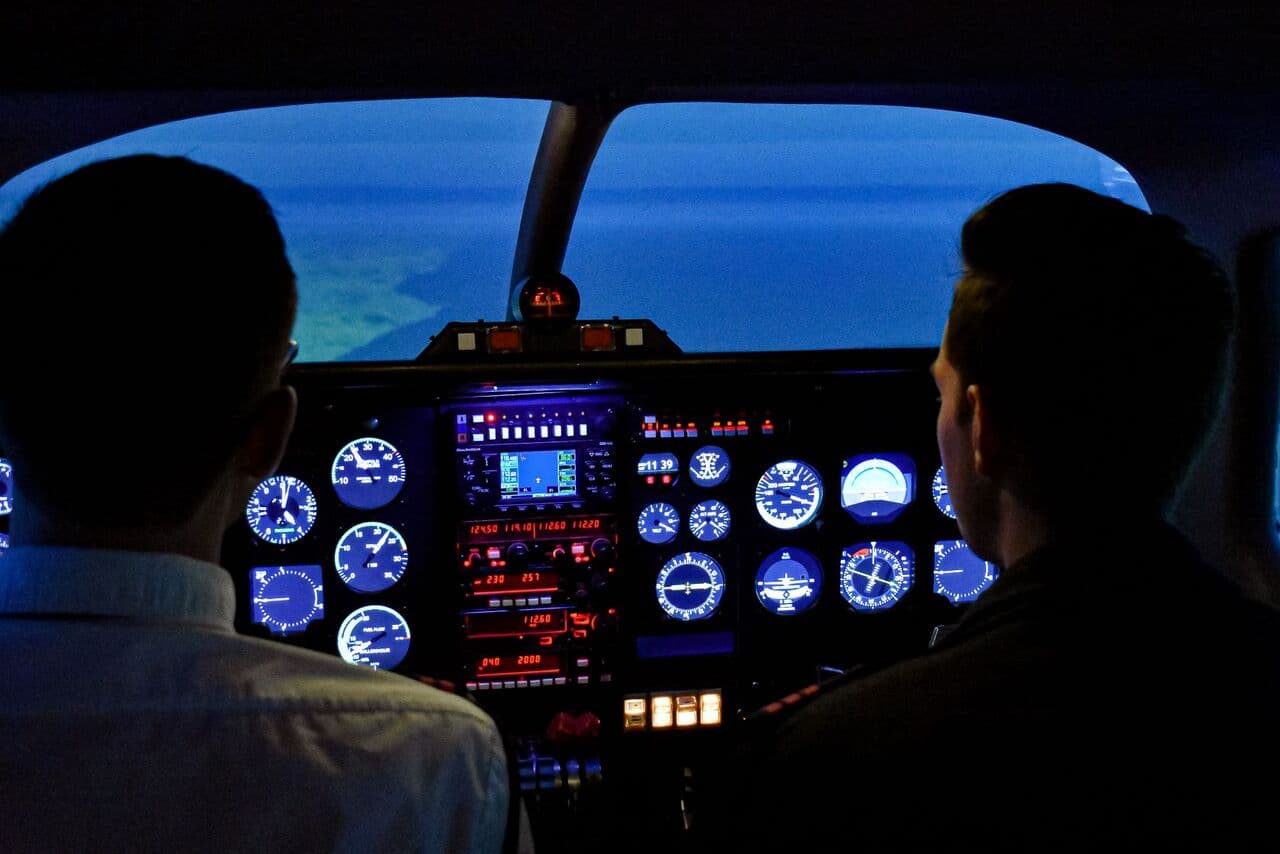
General answerLink to this questionYes — a certified FNPT II with GNSS and RNAV capability.
A flight and navigation procedures trainer, not a game and not a substitute for the aircraft. It is where instrument flying and advanced procedures get cheap to repeat, whatever the weather.
General answerLink to this questionHangar 58A, Wonderboom National Airport (FAWB), Pretoria.
A working airport with other traffic and a control tower — the briefing rooms, examination stations, simulator and fleet are all on one site.
General answerLink to this questionYes — there are 14 briefing rooms, seven examination stations and the simulator on site.
Arrange a visit and you can see where the ground work happens as well as where the aircraft live.
General answerLink to this question
Before you begin
Enrolling and next steps
What happens when you get in touch.
Tell the team where you are starting from and what you want flying to become.
That first conversation decides the route. Nothing is committed and nothing is paid at that stage.
General answerLink to this questionNo. An enquiry is a conversation — nothing is booked, signed or paid.
Formal enrolment comes later, with confirmed training choices, documents and payment arrangements, and only when you are ready.
General answerLink to this questionThe team reviews it, contacts you, and helps you work out the right next step.
If documents are needed, they will tell you how to send them safely. Formal enrolment and paperwork follow only when you decide to go ahead.
No response time is promised here, because none has been published.
General answerLink to this questionNothing at first. Documents are requested once a route is agreed.
Depending on your situation that may include identification, a medical certificate, and — if you have flown before — your logbook and training records.
The exact requirement depends on your intended training and current experience. Eagle Air will confirm this with you before formal enrolment.
Requires document reviewLink to this questionYes. Plenty of enquiries come from a parent or a funding organisation.
Say who is enquiring and who would be training, and the team will take it from there.
General answerLink to this questionThen say that. It is a common and entirely reasonable starting point.
Choose a goal rather than a licence, and the team will work out the route with you.
General answerLink to this question
The words
Aviation, in plain language.
Enough to follow a conversation about your own training. Open one to read what it means.
A school approved by the authority to train pilots. Eagle Air is ATO 1082.
The authority that sets the rules, runs the examinations and issues the licences.
Fly an aircraft yourself and carry passengers, but not for payment.
Fly as a pilot for payment. The licence a flying career is built on.
The highest pilot licence, for command of multi-crew aircraft such as airliners.
An addition to a licence you already hold, extending what you are allowed to do.
Adds the privilege of flying after sunset.
Adds the ability to fly on instruments alone, without outside visual references.
Moves you from single-engine aircraft to twins.
Qualifies you to teach student pilots.
The pilot responsible for the flight. Higher licences require a minimum of this time.
Flying with an instructor beside you.
Flying the aircraft alone, once your instructor authorises it.
Flying to accumulate the experience a higher licence requires.
The theory behind safe flying — air law, meteorology, navigation and more — each with an examination.
The standard radio procedures and phraseology pilots use.
The aviation-English assessment a pilot licence requires.
A certified simulator for procedures and instrument flying. Not a game, and not a substitute for the aircraft.
Satellite navigation, as used for modern instrument approaches.
Licensed pilots hiring a school aircraft to fly themselves, subject to assessment and authorisation.
Still unsure?
Some answers depend on where you are starting.
Tell us about your experience and what you want flying to become. The training team can help you identify the next step.