01
You want to fly for yourself
The PPL may be all you need. It lets you fly for personal enjoyment or recreation, and carry non-commercial passengers in daytime, good-weather conditions.

Private Pilot Licence (PPL)
The Private Pilot Licence is where flying becomes something you can do — not only something you have imagined. Learn the skills, judgement and confidence to take command of an aircraft for private flying.
Where to begin
For almost everyone, yes. The Private Pilot Licence is the foundation: whether you want to fly for your own enjoyment or build a professional career, this is the licence that comes first.
01
The PPL may be all you need. It lets you fly for personal enjoyment or recreation, and carry non-commercial passengers in daytime, good-weather conditions.
02
The PPL is the first milestone. It's the prerequisite for the Commercial Pilot Licence, and everything after it builds on the skills you learn here.
The licence itself
A licence is permission with limits. Here's the honest shape of it.
Paid flying requires a Commercial Pilot Licence, and operations under a valid operator's certificate.
From beside the aircraft to in command
Theory and flying run side by side, from your first lesson to your flight test.
Chapter 01
Step 01
What the licence requires, and what you'll need to begin.
Milestone: Class 2 medical certificate in hand
Training begins with enrolment, a medical assessment, and access to a full pilot kit and the ground school programme. International students arrange the appropriate study visa before training begins.
Step 02
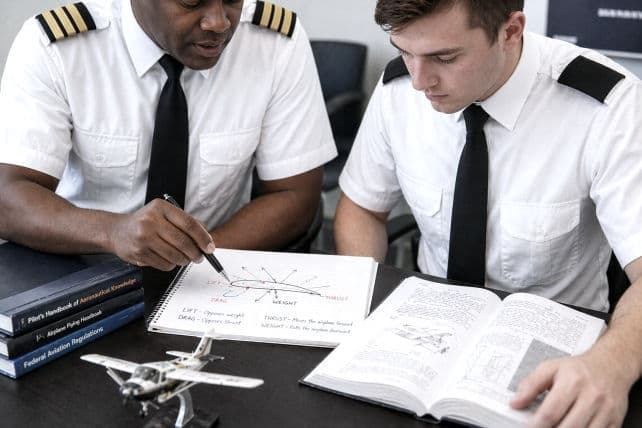
Air law, meteorology, navigation, flight planning, human performance and aircraft technical knowledge.
Milestone: Eight SACAA examinations
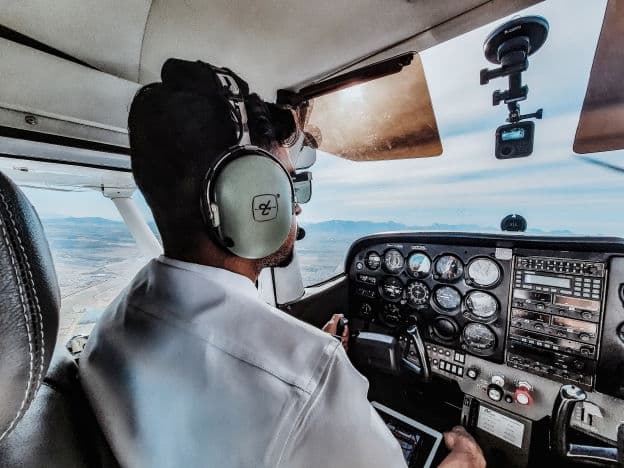
Ground school is compulsory and covers every subject behind your examinations. Lessons are structured, with guided instruction and regular assessments to track your progress. You can attend in person, or study online at your own pace — both cover the same standard.
Chapter 02
Step 03
Handling the aircraft with an instructor beside you: take-offs, circuits and landings.
In the air you start with dual instruction, building the handling skills and habits your first solo depends on. A minimum of 25 hours of your training is flown with an instructor.
Chapter 03
Step 04The moment it becomes yours
Flying the aircraft alone — the moment the training becomes yours.
Milestone: First solo flight
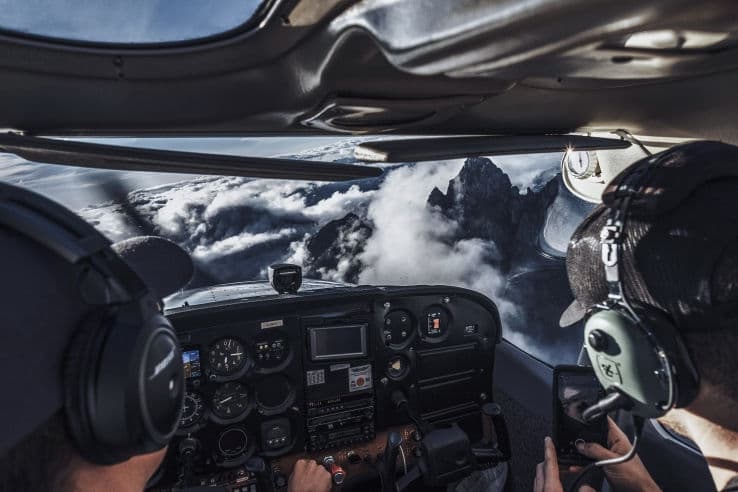
Your instructor steps out and you fly the circuit on your own. It's the milestone every pilot remembers, and the point from which the rest of your training builds.
Chapter 04
Step 05
Consolidating your handling, and flying more demanding exercises.
Milestone: 15 hours solo flying
From your first solo you progress through solo flying and advanced manoeuvres, building the hours and the judgement the licence requires.
Step 06
Planning and flying real routes beyond the training area.
Milestone: 5 hours solo cross-country
Step 07
Demonstrating that you can operate the aircraft safely and confidently.
Milestone: PPL flight test
The course concludes with a practical skills test, where you demonstrate your ability to operate an aircraft safely and confidently. Pass it, with your examinations and radio licence complete, and the licence is yours.
Standard phraseology, radio procedures and the equipment behind them — taught with both theory and real and simulated radio exercises.
The aviation-English assessment your licence requires, with training if it's needed.
Training hours are minimum requirements and may vary depending on individual progress.
Knowledge, handling and judgement
Becoming a pilot is knowledge, handling and judgement together — not one of the three.
No surprises
Three different things, kept apart: what you need before you start, what you complete during training, and what's required before the licence is issued.
01
What you need in place to begin training.
Typically 15 to 16 years old to begin training
You can train before you're old enough to hold the licence.
Licence requirementA valid Class 2 Aviation Medical Certificate
Issued by an approved aviation medical examiner. We'll point you to one.
Licence requirementNo strict school subject requirements
A basic understanding of mathematics and science is an advantage, not a condition.
Eagle Air guidanceInternational students: the appropriate study visa
Secured before training begins.
Licence requirement02
What you complete with Eagle Air.
Complete the ground school syllabus and pass 8 SACAA examinations
Licence requirementA minimum of 45 hours total flying time
Of which at least 25 hours is dual flight training with an instructor.
Licence requirementA minimum of 15 hours solo flying
Of which at least 5 hours is solo cross-country.
Licence requirementPass a Restricted Radiotelephony course
Licence requirementComplete an English Language Proficiency (ELP) assessment
And ELP training if it's required.
Licence requirement03
The final requirements for the licence itself.
Be at least 17 years of age
Licence requirementPass the practical skills test (PPL flight test)
Licence requirementLicence requirement is set by the regulator; Eagle Air guidance is our own advice, not a condition of entry.
Honest numbers
Approximately 4–6 months
Eagle Air’s own guidance · PPL page — how it works
On average, a Private Pilot Licence can be completed within approximately six months. (FAQ — how long does it take)
45 hours is the legal minimum, not a plan. Training hours are based on minimum requirements and may vary depending on individual progress, and infrequent training may mean exceeding them.
What it costs
Eagle Air doesn't publish a single PPL price, because the honest total depends on the hours you actually fly. Rather than a 'from' figure that no one pays, the team will build you an estimate.
The hours you actually fly
The 45-hour minimum is the floor. Less frequent training can mean exceeding the minimum hours, which has cost implications.
How often you train
Regular flying tends to consolidate skills in fewer hours than long gaps between lessons.
When you're ready for the exams and the test
Examinations and the skills test come when you're prepared for them, not on a fixed date.
What Eagle Air includes and what you arrange yourself is confirmed with the training team.
The horizon after this one
A licence to enjoy, and a foundation to build on.
Next · 01
Keep flying after sunset — and the next step on the professional route.
Next · 02
Hire aircraft for your own flying, and join organised fly-away trips across South Africa.
Next · 03
Fly for a living. The PPL is its prerequisite, with instrument and multi-engine training along the way.
Your first step
Tell us what you want flying to become. The Eagle Air team can help you understand the route, the requirements and a realistic training plan from where you are now.